Laser Tattoo Removal vs. Tattoo Cover-Ups: Real Costs and Design Limitations
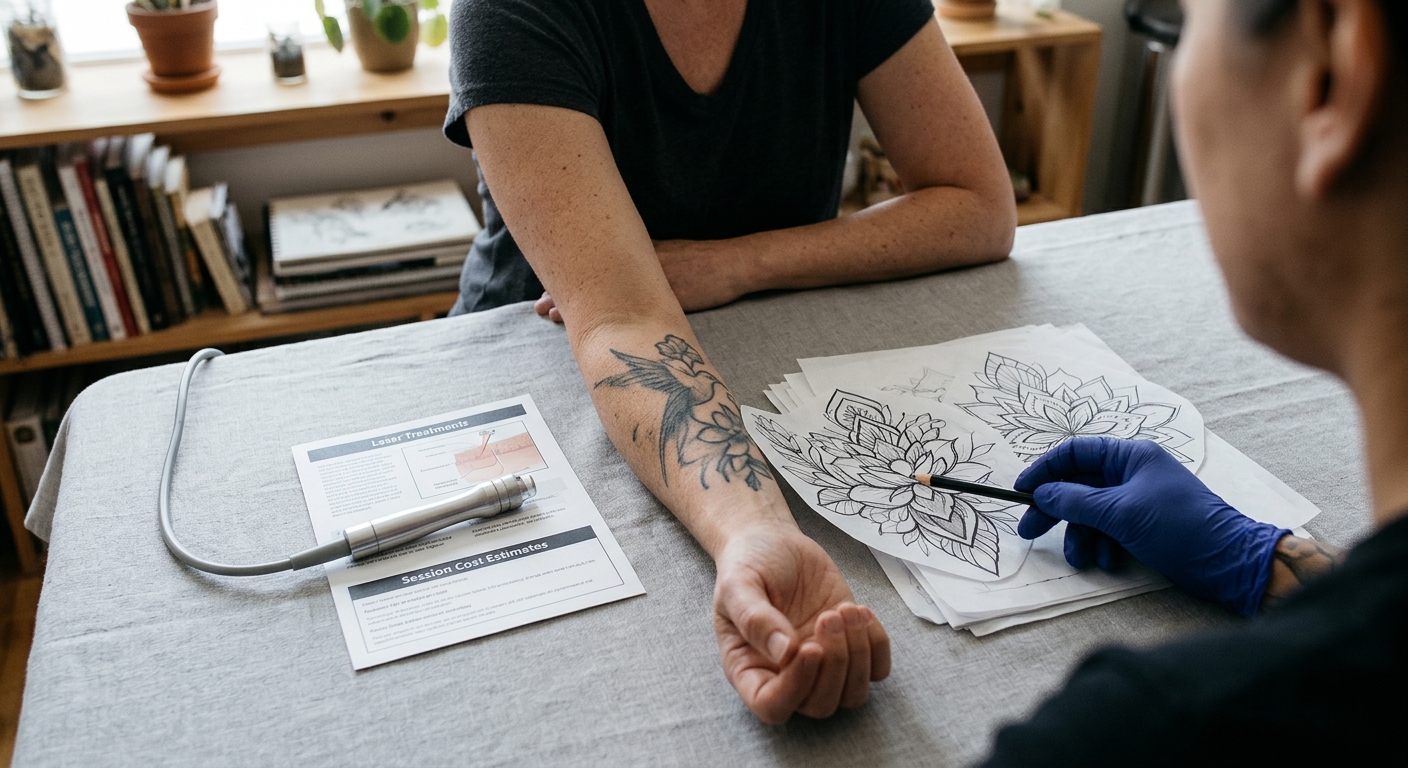
Replacing an unwanted tattoo usually comes down to three options: covering it directly with fresh ink, removing it completely using laser treatments, or fading the existing pigment with a few laser sessions before applying a new design. A direct cover-up provides the fastest turnaround and lowest initial expense, but it forces you into a larger, darker piece. Complete laser removal returns your skin to a bare state, but it requires a multi-year timeline and significant clinical cost. Fading the ink first sits between both paths, opening up lighter design choices without requiring total pigment clearance.
Direct Cover-Ups: Artwork Constraints, Size Requirements, and Color Limits
A direct cover-up does not erase underlying ink. Tattoo needles deposit fresh pigment into the dermis, where it resides alongside existing ink. Because fresh ink mixes visually with settled pigment once healed, the original design directly dictates what an artist can create.
Dark, dense black lines and heavy shading present the primary challenge. As fresh tattoo ink heals, underlying dark lines tend to show through lighter overlay colors. Light pigments—including yellow, sky blue, soft pink, and white—cannot conceal dark black or navy line work. To mask saturated underlying ink, your artist must use deep tones such as dark purple, forest green, midnight blue, or solid black.
Cover-up tattoos also require a larger footprint than the original piece. Artists generally need two to three times the surface area of the original tattoo to disguise it effectively. This additional space allows the artist to align dark background shading over old lines while placing detailed, lighter elements onto surrounding clean skin, shifting visual attention away from the covered design.
Artistic styles are equally constrained. Highly textured, organic patterns—such as dense botanicals, detailed foliage, animal scales, or intricate traditional illustrative work—hide underlying shapes far better than minimal geometric lines or designs featuring broad areas of open, un-inked skin.
Complete Laser Removal: Timelines, Ink Variables, and Skin Response
Laser tattoo removal uses focused light wavelengths to break down trapped ink particles in dermal tissue into smaller micro-fragments. The body's immune system then gradually processes and clears these fragments through lymphatic channels over several weeks.
Achieving total clearance is a slow process. Because internal immune processes do the heavy lifting, treatments are spaced six to eight weeks apart—and often longer for high pigment densities. Treating skin too frequently increases the risk of tissue scarring without accelerating ink removal. As a result, complete clearance typically takes eight to twelve sessions spanning 12 to 24 months.
Several variables determine how quickly ink responds to laser energy:
- Ink Color: Black pigment absorbs broad laser wavelengths efficiently, making it the most responsive color. Light greens, bright blues, yellows, and vibrant neon shades require specialized laser wavelengths and typically demand extra treatment cycles.
- Tattoo Location: Areas with high vascularity and strong lymphatic drainage, such as the chest, neck, and upper arms, clear faster than distant extremities like ankles, feet, or fingers.
- Pigment Depth and Density: Heavy professional tattoos placed deep within the dermal layer take noticeably longer to clear than lighter, shallow line work.
- Skin Tone and Pigmentation: Higher Fitzpatrick skin types (darker skin tones with higher melanin concentration) require conservative laser energy settings to reduce the risk of post-inflammatory hyperpigmentation or hypopigmentation. Lower energy levels and extended rest periods between appointments help protect surrounding tissue.
Fading Existing Ink: Pre-Treatment for Broader Cover-Up Choices
Choosing between complete laser removal and a direct cover-up does not require an all-or-nothing approach. Hybrid fading involves undergoing two to four laser sessions to break down heavy black lines and dark shading before visiting a tattoo artist for a new design.
Pre-fading reduces a dense, dark tattoo to a muted grey shadow. Reducing pigment density removes the harsh technical limitations of a direct cover-up.
Lightening the base ink prevents you from being locked into a massive, dark piece. Your tattoo artist gains access to a broader color palette, can include open skin highlights, and can keep the new design much closer to the original footprint. While pre-fading adds a few months of clinical treatment before getting fresh ink, it saves time and money compared to complete clearance while yielding better artistic flexibility.
Comparing Costs: Hypothetical Scenarios for Each Approach
To compare the financial investment across all three pathways, consider a hypothetical scenario involving a 3-inch by 3-inch black line tattoo on the forearm.
The figures below use explicit baseline assumptions for illustrative purposes. Actual clinic fees, regional rates, and artist pricing will vary.
Option A: Complete Laser Removal (Hypothetical)
- Assumptions: 10 laser sessions needed for full clearance at a flat clinic rate of $200 per session.
- Formula: 10 sessions × $200 per session = $2,000 total spend.
- Timeline: 15 to 18 months, assuming 6 to 8 weeks of healing time between sessions.
Option B: Direct Cover-Up Tattoo (Hypothetical)
- Assumptions: Custom cover-up design requiring double the original tattoo surface area, taking 5 total hours at an artist rate of $180 per hour, plus $50 for aftercare products.
- Formula: (5 hours × $180 per hour) + $50 aftercare = $950 total spend.
- Timeline: 4 to 6 weeks, covering consultation, application, and surface skin healing.
Option C: Laser Fading Followed by Cover-Up Tattoo (Hypothetical)
- Assumptions: 3 laser fading sessions at $200 per session, followed by a 3.5-hour cover-up tattoo at $180 per hour, plus $50 for aftercare products.
- Formula: (3 laser sessions × $200) + (3.5 tattoo hours × $180) + $50 aftercare = $600 + $630 + $50 = $1,280 total spend.
- Timeline: 6 to 8 months, allowing for fading cycles, complete tissue recovery, and new tattoo healing.
Direct cover-ups require the lowest financial layout and the shortest timeframe, but they demand significant compromise on artwork style and size. Complete removal leaves bare skin but carries the highest overall cost and longest schedule. Pre-fading balances financial cost while restoring design flexibility.
Healing Timelines and Dermal Tissue Recovery
Managing tissue health is essential when planning any removal or cover-up strategy. Epidermal recovery after a fresh tattoo takes roughly two to three weeks while the surface layer sheds and seals. However, deep dermal recovery and ink stabilization take up to three months.
Laser treatments cause temporary thermal trauma beneath the skin. Common post-session effects include localized redness, swelling, blistering, and minor pinpoint bleeding. Resting skin for six to eight weeks between laser treatments lets the dermal layer repair its structural integrity while micro-particles clear through the lymphatic system.
If you choose to fade ink before getting a cover-up, you must allow complete dermal recovery before tattooing over the treated area. Applying tattoo ink to inflamed or recently lasered tissue increases the risk of permanent scarring, poor pigment retention, and blurred linework. Practitioners generally advise waiting at least 8 to 12 weeks after your final laser fading session before applying new tattoo ink.
Practical Decision Worksheet for Your Next Step
Evaluating your priorities helps clarify which strategy fits your schedule, budget, and aesthetic expectations.
- Choose a Direct Cover-Up if:
- You need the project finished within a few weeks.
- You are comfortable doubling or tripling the overall size of the existing tattoo.
- You favor dark, illustrative, or densely shaded art styles, such as detailed florals or dark traditional pieces.
- You want to limit your total expenditure to under $1,000.
- Choose Complete Laser Removal if:
- Your target outcome is bare skin with no tattoo in that location.
- You can commit to a 12- to 24-month treatment schedule.
- Your budget covers 8 to 12 or more individual clinical sessions over time.
- You can strictly follow long-term sun protection and aftercare routines.
- Choose Hybrid Fading + Cover-Up if:
- You want a specific replacement design featuring fine lines, lighter colors, or open skin space.
- Your current ink is dense black pigment that would force a direct cover-up to be excessively large or dark.
- You can wait 6 to 8 months from start to finish.
- You want to keep total costs moderate while giving your tattoo artist room to execute your preferred vision.
Before scheduling appointments, book a consultation with a certified laser specialist to assess pigment depth and skin type, followed by a meeting with a tattoo artist who specializes in cover-up work to discuss realistic design possibilities.
Post Comment