How to Design a Custom Tattoo: A Beginner’s Guide to Bringing Your Vision to Life
So, you’ve decided to get inked. But not just any off-the-wall flash design—you want something that is uniquely, unapologetically you. A custom tattoo is like a bespoke suit for your skin; it is a permanent piece of wearable art that tells a story only you can narrate. But how do you bridge the gap between that vague, beautiful chaos inside your head and a stunning masterpiece on your body? Designing a custom tattoo can feel a bit overwhelming, especially if you are a beginner, but the journey is just as rewarding as the final result. Let’s break down the creative process step by step, turning your raw ideas into a striking reality.
—
Why Go Custom? The Magic of a Unique Tattoo
While walking into a shop and pointing to a cool skull on a flash sheet has its own classic charm, a custom tattoo is a completely different beast. When you opt for a custom design, you are collaborating with an artist to build something from scratch. It is an investment in your personal history, your aesthetic tastes, and your identity.
Think of your body as an empty gallery wall. Do you want to hang a mass-produced print that thousands of others own, or do you want an original commission that speaks directly to your soul? Custom designs allow you to tailor every single line, shade, and color to fit the exact contours of your body and the depth of your personal narrative.
—
Phase 1: Finding Your Inspiration Spark
Every great tattoo starts with a single spark. You don't need to know exactly what the final drawing looks like yet—that is what your artist is for. Right now, your job is to gather the raw ingredients.
Digging Into Personal Meaning and Symbolism
Does your tattoo need to have a deep, tear-jerking meaning? Absolutely not. "Because it looks cool" is a perfectly valid reason to get inked. However, if you do want your tattoo to carry emotional weight, start by listing the core themes you want to represent.
Are you celebrating a major life transition, honoring a loved one, or expressing your love for a specific subculture? Instead of searching for literal translations, think metaphorically. If you want to represent resilience, instead of just tattooing the word "Strong," think about a wild anchor holding fast in a storm, a phoenix rising from geometric ashes, or a delicate wildflower pushing through a crack in concrete.
Creating a Visual Mood Board
Once you have a general concept, it’s time to start hoarding visual inspiration. Create a dedicated folder on your phone, a Pinterest board, or an Instagram saved collection.
Don't limit yourself strictly to photos of other tattoos. In fact, looking too much at existing tattoos can accidentally lead to copying. Instead, expand your horizon to include:
- Classical oil paintings or modern digital art
- Botanical illustrations and architectural sketches
- Textures, fabric patterns, and color palettes
- Stills from your favorite films or pages from graphic novels
—
Phase 2: Decoding Tattoo Styles
Before you can communicate your vision to an artist, you need to speak their language. Tattooing isn't a one-size-fits-all medium. It is an art form split into dozens of distinct styles, each with its own rules, history, and aesthetic vibe.
Traditional vs. Neo-Traditional
If you love bold black outlines and bright, saturated primary colors, American Traditional (think Sailor Jerry) might be your calling. These tattoos are designed to look striking from across the room and age incredibly well.
If you want those same bold lines but with more complex color gradients, illustrative details, and organic subject matter (like art nouveau portraits or highly detailed animals), then Neo-Traditional is your perfect match.
Fine Line and Micro-Realism
Are you drawn to delicate, whisper-thin designs that look like they were drawn with a mechanical pencil? Fine Line tattooing has exploded in popularity, offering a minimalist, elegant aesthetic.
Taking it a step further, Micro-Realism uses incredibly tiny needles to pack photographic detail into small spaces. While breathtakingly beautiful, keep in mind that these styles require an absolute master of the craft, as delicate lines can fade or spread faster over the decades if not applied perfectly.
Illustrative and Watercolor
If you want your tattoo to look like a page ripped straight out of a children's storybook, a sketchpad, or an abstract painting, look into Illustrative or Watercolor styles. Illustrative tattoos combine elements of traditional shading with a distinct "drawn" quality, while watercolor tattoos mimic fluid, borderless paint splashes that blend beautifully across the skin.
—
Phase 3: Placement and Sizing Decoded
A design that looks incredible flat on a piece of paper might look completely distorted once it is wrapped around a human bicep. Your body is not a flat canvas; it is a dynamic, moving, three-dimensional sculpture.
How Anatomy Affects Your Design
When thinking about where your custom tattoo will live, you have to consider how your muscles and joints move. A good custom tattoo design doesn't just sit on top of your skin—it flows with it.
The Flow and Curve of the Body
An experienced tattoo artist will design your piece to follow the natural muscle groups. For example, a snake or a floral vine should wrap naturally around the forearm, accentuating the muscle rather than cutting awkwardly across it. If you place a perfectly rigid geometric circle directly over a muscle that flexes and stretches, that circle will look like an oval half the time. Your artist will help you adjust the design so it looks great whether you are standing still or moving around.
Pain Scale and Skin Stretching
Let’s be real for a second: tattoos hurt. But they hurt differently depending on where you put them. Areas with thin skin directly over bone (like the ribs, collarbones, shins, and feet) or areas with highly concentrated nerve endings (like the inner bicep or armpit) are going to test your pain tolerance.
Furthermore, skin in certain areas—like the stomach, hips, and upper thighs—stretches and changes more over time due to weight fluctuations or pregnancy. Keep these factors in mind when choosing your canvas space.
—
Phase 4: Finding and Collaborating with the Right Artist
This is the most critical step of the entire process. You could have the greatest tattoo concept in human history, but if you pair it with the wrong artist, the execution will fall flat.
Researching Portfolios Like a Pro
Do not just walk into the closest shop on the corner and hope for the best. Use social media—especially Instagram—as your primary search engine. Search hashtags like #YourCityTattoo or #StyleNameTattoo (e.g., #ChicagoFineLine or #AustinNeoTraditional).
When scrolling through an artist’s feed, look for consistency. Zoom in on their photos. Are their lines clean and smooth, or are they shaky and blurry? Are their color fills solid, or do they look patchy? Crucially, look for photos of healed tattoos. A fresh tattoo always looks vibrant and crisp, but a healed photo (at least a few months to a year old) shows you how well the ink actually settled into the skin.
The Consultation: Translating Your Brain to Their Hands
Once you have selected your dream artist, you’ll book a consultation. This is where the magic collaboration begins.
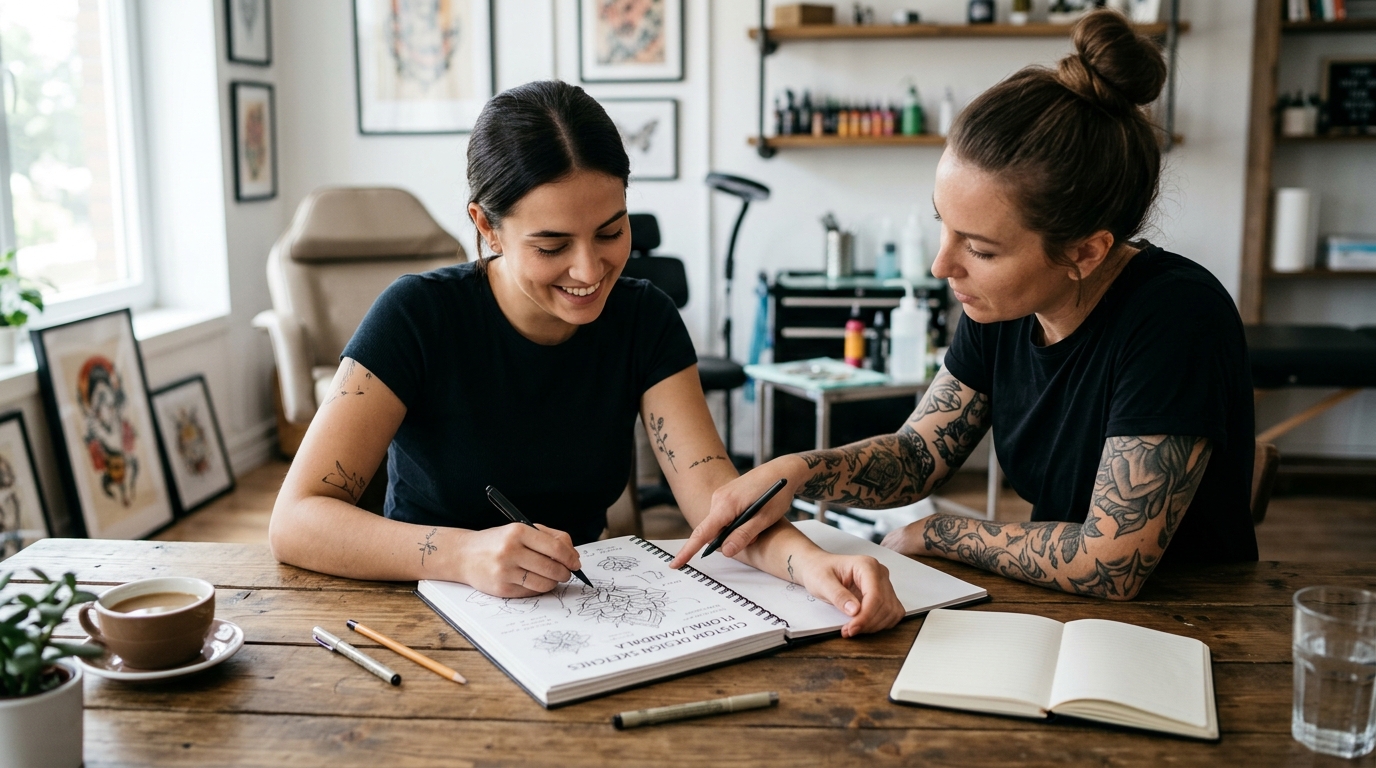
Come prepared, but don't bring a rigid, unchangeable blueprint. Bring your mood board, point out specific elements you love (e.g., "I love the shading on this flower, but the petal shape of this one"), and explain your concept. Let the artist know your preferred size and placement.
Most importantly, ask questions! A great tattoo artist is a visual translator. You give them the story; they turn it into a language that skin can read.
Trusting the Artistic Process (and Setting Boundaries)
Here is a golden rule of custom tattoos: Trust your artist. You chose them because of their unique portfolio, so let them do what they do best. If they tell you that a certain detail is too small and will blur into a blob in five years, believe them. If they suggest shifting the placement slightly to make the design pop, take their advice.
That being said, it is still your body. If there is an element of the design you genuinely do not like, speak up! A professional artist will never have their feelings hurt by polite, constructive feedback. It is a collaborative dance of mutual respect.
—
Phase 5: Refining the Design and the "First Draft"
In the custom tattoo world, don't expect to see your finished design weeks in advance. Most artists will not draw your tattoo until a day or two before your appointment—sometimes even the night before or the morning of.
Why? Because their schedules are packed with other clients, and they want your design fresh in their minds when you walk through the door.
Handling Edits and Redraws Without Awkwardness
When you arrive at the shop, the artist will show you the design. Take a deep breath and look at it closely.
Does it match your vision? If it’s 90% perfect but you want to tweak the background or change a color, tell them. Small changes can easily be made on the spot using digital drawing tablets. If the design is completely off-base, don't panic. Be honest, explain what went wrong in the translation, and be prepared to potentially reschedule your appointment so the artist has time to do a full redraw. It is always better to wait a little longer for a design you love than to rush into something you'll regret.
—
Phase 6: Preparing for Your Big Day
You’ve approved the design, the stencil is ready, and it’s time to sit in the chair. Preparing your body for a tattoo is just as important as preparing the artwork.
- Hydrate, Hydrate, Hydrate: Drink plenty of water in the 24 to 48 hours leading up to your session. Hydrated skin takes ink much easier and heals faster.
- Eat a Solid Meal: Your blood sugar will drop during a long tattoo session due to adrenaline. Eat a hearty meal rich in protein and carbs about two hours before your appointment.
- Dress for the Occasion: Wear loose, comfortable clothing that gives the artist easy, uninhibited access to the area being tattooed. Expect that some ink might get on your clothes, so leave your favorite designer outfit at home.
- Skip the Alcohol: Do not drink alcohol the night before or the day of your tattoo. Alcohol thins your blood, which leads to excess bleeding, diluting the ink and making the artist's job significantly harder.
—
Conclusion
Designing a custom tattoo is a deeply personal, incredibly exciting journey of self-expression. By taking the time to research your favorite styles, curate a thoughtful mood board, and collaborate openly with a skilled artist, you aren't just getting a tattoo—you are creating a permanent masterpiece that you will proudly wear for the rest of your life. Trust the process, communicate clearly, and enjoy the thrill of watching your unique vision come to life on your skin.
—
Frequently Asked Questions
Can I bring my own drawing for the artist to tattoo?
Yes, absolutely! However, keep in mind that unless your artist is purely a "copyist," they will likely need to adapt your drawing slightly so that it works structurally as a tattoo. They will ensure the lines are thick enough to hold up over time and that the shading translates well to skin.
Does a custom tattoo cost significantly more than a flash design?
Generally, yes. Custom tattoos require the artist to spend their personal, non-shop hours researching, drawing, and revising your design. Because of this extra labor, artists usually charge a drawing fee, a higher deposit, or a premium hourly rate for custom work compared to pre-drawn flash.
What should I do if I hate the design my artist shows me on the day of the appointment?
Speak up immediately! Be polite but completely honest. A reputable artist wants you to love your tattoo forever and would much rather reschedule the session to redraw the design than put something on your skin that you aren't thrilled about.
How do I know if my custom design will age well?
The golden rule of tattoo longevity is "bold will hold." Tattoos with strong, clear outlines and smart use of negative space (empty skin) tend to look best as they age. Over time, all tattoo ink spreads slightly under the skin; if your design is packed with too many tiny, microscopic details close together, they may eventually blur into one another.
Can I ask an artist to customize a piece of flash they’ve already drawn?
Most artists are happy to make minor tweaks to their flash designs—such as changing the color palette, adding a banner, or swapping out a floral element. Just ask them during the booking process!
Post Comment