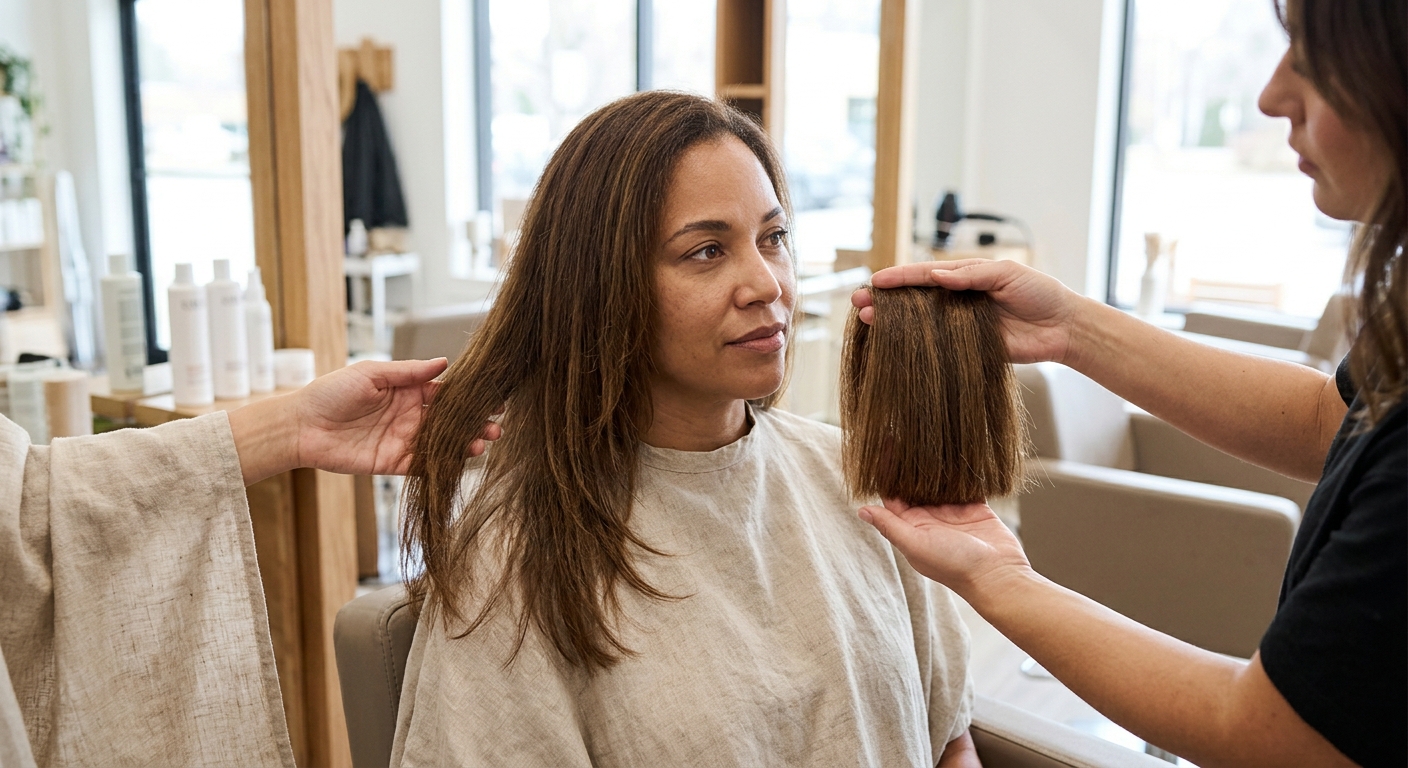
How to Choose Between Long Layers and a Blunt Cut for Your Hair Density
Choose a blunt cut if you have low-density hair that needs edge weight to look full. Choose long layers if you have high-density hair that feels heavy, forms a triangular shape, or lacks movement. Medium-density hair easily supports both styles, making your decision a choice between sleek perimeter edges and layered texture. Hair density—the total number of individual strands on your scalp—determines whether your cut needs to retain perimeter weight or carve out interior mass.
How Hair Density Dictates Haircut Structure
Hair density measures how closely packed individual hair follicles are across your scalp. It is distinct from hair texture, which describes the thickness of each individual strand (fine, medium, or coarse). You can have fine strands with very high overall density, or coarse strands with low density.
A haircut changes how hair falls under its own weight:
- Blunt cuts trim all hair along a single horizontal baseline. Every strand ends at the same length, concentrating maximum density at the bottom perimeter.
- Long layers remove weight at varying heights throughout the interior and exterior of the hair. This diffuses total volume, softens the perimeter, and lets individual sections move independently.
Matching your haircut to your density avoids the two most common styling problems: thin, see-through ends caused by over-layering sparse hair, and a heavy, pyramid-shaped silhouette caused by leaving thick hair uncut at a single length.
Low-Density Hair: Keeping the Baseline Solid with a Blunt Cut
When hair density is low, the main structural goal is preserving weight at the perimeter. Every strand contributes to the visual illusion of thickness along the bottom edge.
A blunt haircut cuts strands straight across at a single length. As the hair hangs naturally, these aligned ends create a dense, opaque line that blocks light from shining through the bottom inches of your style. This creates an immediate impression of fuller, healthier hair.
Why Layers Can Make Thin Hair Look Sparse
Adding traditional layers to low-density hair strips away interior weight that supports the overall shape. When top layers are shortened, fewer strands reach the hemline. This leaves the bottom edge looking wispy, separated, and fragile, even if the hair itself is completely healthy.
The Face-Framing Compromise
If you have low-density hair but want framing around your face, ask your stylist for a blunt baseline across the back with subtle, chin-length face-framing angles in front. This maintains the vast majority of your perimeter density while adding softness around your features.
High-Density Hair: Removing Interior Bulk with Long Layers
High-density hair carries significant internal weight. When left at a single length, the top layers flatten against the head under their own weight while the bottom fans out, creating an unbalanced triangular shape.
Long layers relieve this mass without requiring you to lose overall length. By staggering where strands end between the collarbone and the hemline, your stylist reduces the downward pull on your scalp and roots.
Benefits of Long Layers for Thick Hair
- Scalp relief: Less internal mass lightens the physical weight pulling on your roots, making high ponytails and buns far more comfortable to wear.
- Natural movement: Removing the rigid block of hair lets individual sections sway freely.
- Faster drying times: Air circulates more easily through layered interior sections, shortening blow-drying or air-drying time.
To avoid creating a harsh "shelf" where top layers end, ensure your shortest layer begins no higher than collarbone level on high-density hair.
Medium-Density Hair: Choosing Based on Daily Styling Preferences
Medium-density hair is flexible enough to handle almost any structural design. It has enough baseline volume to accommodate light layering without looking sparse, yet stays light enough to wear a crisp blunt cut without flaring at the bottom.
If you have medium-density hair, make your decision based on your daily styling routine and overall aesthetic:
Choose a blunt cut if:
- You regularly wear your hair straight and sleek.
- You want a sharp, modern perimeter line that looks intentional with minimal daily effort.
- You prefer longer gaps between hair appointments, as blunt hemlines grow out cleanly.
Choose long layers if:
- You routinely air-dry your natural waves or wear soft curls.
- You like volume around the crown and soft framing along your collarbones.
- You use round brushes or curling wands regularly, as layered ends wrap around hot tools and hold shape more easily than blunt ends.
Structural Exceptions: Strand Width and Natural Texture
Hair density does not act alone. Strand thickness and natural wave patterns alter how a haircut behaves.
Fine Strands with High Density
You have a high volume of hair, but each individual strand is slender. A rigid blunt cut can look weighed down, yet aggressive texturizing can cause surface frizz. Ask for long, soft internal layers carved out from the inside while keeping the outer baseline clean.
Coarse Strands with Low Density
You have fewer total hairs, but each strand is wide and stiff. A pure blunt cut can end up looking rigid or blocky at the tips. Ask for a blunt baseline that is lightly point-cut at the very ends to soften the edge without stripping away perimeter weight.
Wavy and Curly Patterns
Curls stack on top of one another naturally. A single-length blunt cut on wavy or curly hair almost always expands into a wide bottom shape regardless of density. Long layers are generally recommended for wavy and curly hair so individual ringlets can fall at varying heights without creating a solid wall of bulk.
Evaluating Your Hair Density
Use this quick diagnostic before booking your next trim to see where your hair falls on the density spectrum:
- Scalp Visibility Test:
- Easily see your scalp without parting your hair: Low density (leaning toward a blunt cut).
- See your scalp primarily along your natural part line: Medium density (flexible options).
- Rarely see your scalp even when pulling hair back: High density (leaning toward long layers).
- Ponytail Circumference Test:
- Gather your hair into a ponytail using a standard hair tie.
- Under 2 inches around: Low density. A blunt cut preserves edge density.
- Between 2 and 4 inches around: Medium density. Choose based on your styling habits.
- Over 4 inches around: High density. Long layers relieve internal weight.
- Drying Time Test:
- Air-dries completely in under 45 minutes: Low density.
- Takes 1 to 2 hours to air-dry: Medium density.
- Takes over 3 hours to air-dry near the root or interior sections: High density.
Clear Salon Phrases for Your Consultation
To ensure your stylist understands your structural goals, use clear descriptions of weight and baseline shape:
- For low-density hair: "I want to keep my baseline completely blunt to maintain maximum density at the bottom. If we add framing around my face, please keep it soft and ensure it starts below my chin so my ends stay full."
- For high-density hair: "My hair gets heavy and forms a triangular shape at the bottom. I would like long, seamless layers to remove interior weight and add movement, with the shortest layer starting near my collarbone so it doesn't leave a harsh shelf."
- For medium-density hair: "I want a clean baseline, but I like wearing loose waves. Can we do a soft blunt cut with subtle interior texturizing at the ends so it stays flexible when heat-styled?"
Maintenance and Upkeep
The maintenance schedule varies based on the geometry of your cut:
- Blunt Cuts: Plan on perimeter trims every 6 to 8 weeks. Precise horizontal lines show uneven growth sooner as individual hair strands grow at slightly different speeds. Applying a light hair oil to the ends preserves a smooth edge line.
- Long Layers: Trims can typically be spaced out to 10 to 12 weeks. Using a lightweight mousse at the roots helps highlight the lift and interior separation that layers provide.
Post Comment