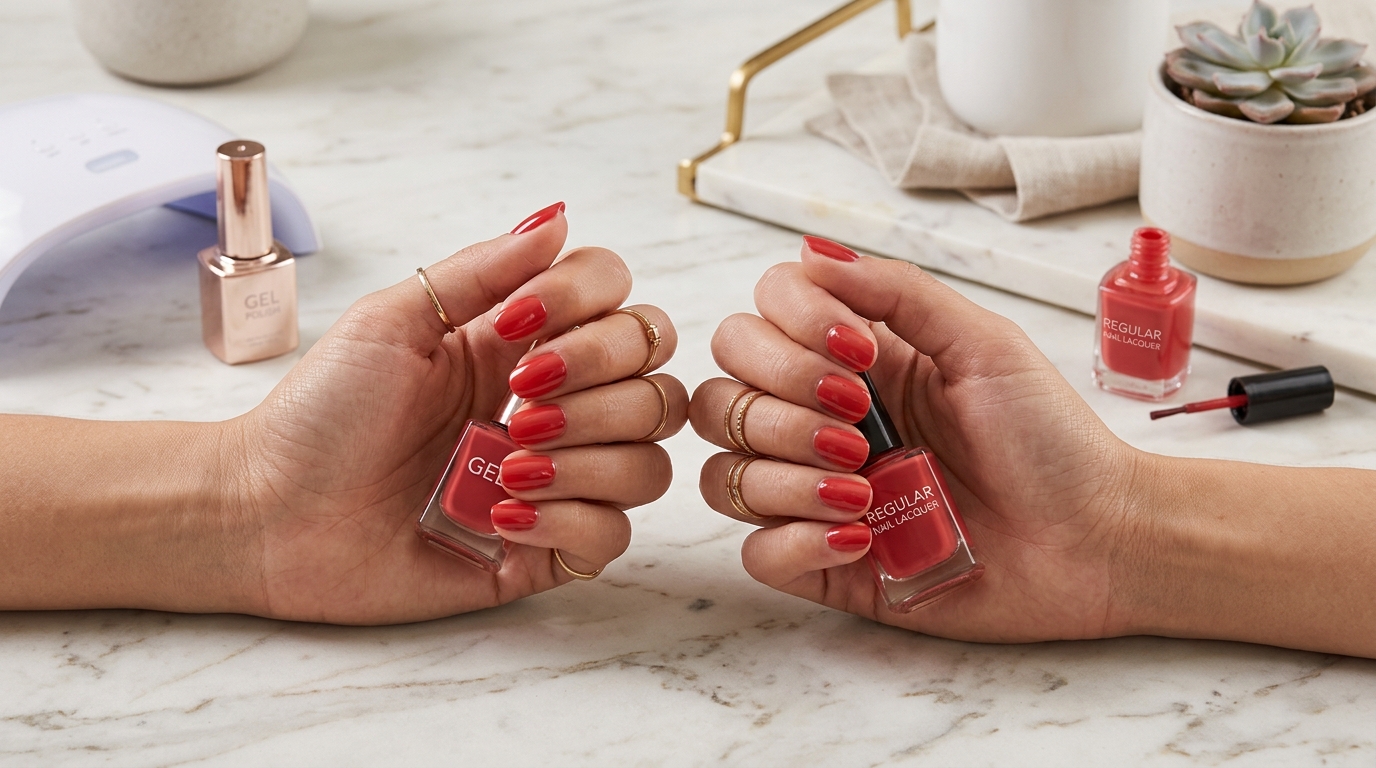
Gel vs. Regular Nail Polish: Which Manicure is Right for You?
Picture this: You’ve just spent forty-five minutes painting your nails to absolute perfection. You sit incredibly still, hands hovering in the air like a surgeon, barely breathing while you wait for them to dry. Then, you reach into your bag to grab your keys, and bam—a giant, ugly smudge right down the middle of your index finger. We’ve all been there, and let’s be honest, it is enough to make you want to scream into a pillow.
This brings us to the ultimate beauty dilemma that has divided nail salons and DIY beauty lovers alike: gel vs. regular nail polish. Whether you are prepping for a demanding work week, packing for a tropical vacation, or simply trying to squeeze in some much-needed self-care, choosing the right manicure can feel like a high-stakes decision. With so many advanced formulas and curing technologies available today in 2026, the playing field has changed. Let’s dive deep into the ultimate battle of the polishes to find out which one deserves a permanent spot on your fingertips.
## The Great Manicure Debate: Gel vs. Regular Polish
For decades, getting a manicure was a straightforward affair. You picked a color, sat down, got your nails painted, and hoped for the best as you walked out the door. Today, the nail industry is a multi-billion-dollar powerhouse filled with acrylics, dip powders, builder gels, and classic lacquers. Yet, the core debate almost always comes down to two main contenders: gel and regular polish.
Choosing between them isn't just about picking a color; it’s about choosing a lifestyle. Are you looking for a quick, low-commitment pop of color that you can swipe off on a whim? Or do you need a bulletproof, high-gloss shield that can survive dishwashing, typing marathons, and gym sessions without a single scratch? To make the right call, we need to lift the hood and look at what makes these two options tick.
## Understanding the Basics
Before we pit these two head-to-head, let's break down exactly what we are putting on our nails. Though they might look identical sitting in their glass bottles on a salon shelf, their chemical DNA is worlds apart.
### What Exactly is Regular Nail Polish?
Regular nail polish, often called nail lacquer, is the classic formula we all grew up with. It is a liquid mixture of refined polymers, resins, plasticizers, and color pigments dissolved in a solvent. When you apply it to your nails, you don't need any special equipment to make it dry. Instead, the process relies entirely on air.
As the liquid solvents evaporate into the air, the remaining ingredients fuse together, leaving behind a hardened, colored film on your nail plate. It is simple, straightforward, and has been the backbone of personal grooming for nearly a century.
### What is Gel Nail Polish?
Gel nail polish is a completely different beast. It is not just "thick regular polish." Chemically speaking, gel polish is made of acrylic monomers and oligomers that remain in a liquid state until they are exposed to a specific wavelength of light.
Unlike regular polish, gel will never dry on its own. You could sit in a room for three days, and it would remain as wet and sticky as the moment you brushed it on. It requires a specialized UV or LED lamp to trigger a chemical reaction that bonds the molecules together into a hard, plastic-like coating.
#### The Science of the Cure
This chemical transformation is known as polymerization, or more commonly, "curing." Inside the gel formula are tiny molecules called photoinitiators. When the light from an LED or UV lamp hits these photoinitiators, they absorb the energy and kick off a chain reaction, linking the liquid monomers into a tough, cross-linked polymer network.
Think of regular polish as a watercolor painting that dries as the water evaporates. Gel polish, on the other hand, is like a raw ceramic glaze that must be baked in a kiln to achieve its final, indestructible form.
## The Showdown: Key Differences Analyzed
Now that we know the science, let's look at how these two contenders perform in the real world. We’ve broken down the battle into five crucial categories: application, drying time, longevity, shine, and removal.
### Application Process: Speed vs. Precision
Applying regular polish is a breeze. You apply a base coat, two thin layers of color, and a top coat. If you make a mistake and get some on your skin, it is incredibly easy to clean up with a tiny brush dipped in remover.
Gel application requires a bit more discipline. Because the gel must cure under a lamp, any polish left on your skin or cuticles will cure right there, creating an edge that will cause the entire manicure to peel off prematurely. You have to apply incredibly thin, precise layers and cure each one individually. However, because it doesn't dry in the air, you can take your sweet time perfecting your brush strokes without worrying about the polish dragging or getting gummy.
### Drying Time: The Waiting Game
If you despise waiting, this is where the scale tips dramatically. Regular polish is notoriously deceptive. It might feel dry to the touch after fifteen minutes, but it actually takes up to twenty-four hours to fully cure through all the layers. One wrong move hours after your manicure, and you’ll end up with a fabric texture imprinted onto your nails from your bedsheets.
Gel polish wins the speed round hands down. The moment your hand leaves that LED lamp after the final cure, your nails are 100% dry. You can immediately dig through your purse, wash your hair, or even go rock climbing. There is zero risk of smudging, denting, or ruining your fresh paint job.
### Longevity: How Long Will It Actually Last?
Let's face it: we want our nails to look good for as long as possible. Regular polish is highly susceptible to chipping, especially if your hands are constantly in water or if you do a lot of typing. On average, a regular manicure will look pristine for about three to five days. If you are extremely careful, you might stretch it to a week, but minor edge wear is almost guaranteed by day four.
Gel is the undisputed heavyweight champion of longevity. A properly applied gel manicure easily lasts two to three weeks without a single chip, crack, or dull edge. In fact, the only reason most people remove their gel is because their natural nails have grown out so much that there is an obvious gap at the cuticle line.
### The Shine Factor: Glossy vs. Natural
There is a distinct visual difference between the two finishes. Regular polish has a beautiful, natural-looking shine when first applied, but that luster tends to fade over the course of a few days as it encounters daily friction, soaps, and hand creams.
Gel polish is famous for its wet-look, mirror-like gloss. It retains its brilliant, glassy shine from day one until the day you take it off. If you love that ultra-polished, high-maintenance look that looks like you just stepped out of a luxury salon, gel is your best friend.
## The Health and Damage Report
No beauty discussion is complete without talking about nail health. We have all heard the horror stories of nails left paper-thin, peeling, and ruined after a manicure. But who is the real culprit here?
### Does Gel Polish Damage Your Natural Nails?
Here is a truth bomb: gel polish itself does not damage your nails. The damage almost always happens during the removal process.
Because gel is designed to bond tightly to the nail plate, trying to peel, pick, or scrape it off when it starts to lift is a recipe for disaster. When you peel off gel, you are literally ripping off the top layers of your natural nail plate along with it. If you remove gel correctly and gently, your natural nails will remain perfectly healthy and strong underneath.
### The UV/LED Light Question: Is It Safe?
It is completely valid to wonder about the safety of sticking your hands under a light machine every few weeks. UV radiation is associated with skin aging and damage.
To put things in perspective, modern LED lamps cure polish much faster than older UV models, meaning your exposure time is incredibly brief—usually only a couple of minutes total per manicure. However, if you want to be absolutely safe, you can apply a broad-spectrum sunscreen to your hands twenty minutes before your appointment, or wear fingerless UV-protection manicuring gloves.
### The Removal Process: Gentle vs. Intensive
This is where regular polish clawed back some serious points. Removing regular polish is a sixty-second affair. A cotton pad soaked in regular nail polish remover (even acetone-free versions) will swipe the color away instantly, leaving your nails clean and ready for their next look.
Gel removal is an exercise in patience. It requires soaking your nails in pure acetone for ten to fifteen minutes to break down the hardened polymer bonds. You either have to wrap your fingertips in foil with acetone-soaked cotton balls or submerge them in a glass bowl. Once the gel has bubbled up and softened, it must be gently nudged off with a wooden cuticle stick. It is time-consuming and can temporarily dry out the surrounding skin and cuticles.
## Cost and Convenience: Salon vs. DIY
How much time and money are you willing to invest in your nail game? The math looks very different depending on which path you choose.
### The Price Tag: Initial and Long-Term Costs
Regular polish is incredibly budget-friendly. You can buy a high-quality bottle of classic lacquer for under $10, and that single bottle will last you for dozens of manicures. You don't need any special equipment, making the cost per use mere pennies.
Gel manicures are a larger financial commitment. At a professional salon, a gel manicure typically costs significantly more than a regular one. If you want to do it yourself, you have to invest in a curing lamp, specialized gel base and top coats, and gel colors. While the initial setup cost is higher, it easily pays for itself after a few DIY sessions.
### Can You Do Gel at Home?
Absolutely! The DIY nail scene has exploded with incredible home gel kits that rival professional salon setups. Today, we have access to safer, HEMA-free formulas (which minimize the risk of skin allergies) and compact, smart LED lamps that plug right into your laptop.
However, doing gel at home does require a learning curve. You need a steady hand, a clean workspace, and the patience to prep your nails properly by pushing back cuticles and gently buffing away natural oils to ensure the gel adheres correctly.
## Which One is Right for Your Lifestyle?
Still on the fence? Let’s look at three common lifestyle scenarios to see where you fit in.
### The Active Adventurer
Do you spend your weekends hiking, gardening, lifting weights at the gym, or swimming? If your hands are constantly taking a beating, regular polish will likely chip within twenty-four hours. For you, gel is like a protective suit of armor. It strengthens your natural nails, prevents them from snapping under pressure, and stays flawless through all your adventures.
### The Fast-Paced Professional
If your calendar is packed with back-to-back meetings, travel, and presentations, you don't have time to worry about chipped polish making you look unpolished. You also don't have forty-five minutes to sit around waiting for your nails to dry. Gel is your ultimate match. It offers a reliable, low-maintenance solution that keeps you looking put-together for weeks with zero daily effort.
### The Trend Hopper
Do you get bored easily? Do you love matching your nails to your weekend outfits, or do you find yourself wanting a fresh color every few days? If so, gel will feel like a golden cage. It lasts too long for someone who wants frequent change, and the arduous removal process will quickly become a chore. Regular polish is your playground. It allows you to experiment with colors, textures, and designs on a whim without any commitment.
## The Verdict: Making Your Choice
At the end of the day, there is no single "winner" in the battle of gel vs. regular nail polish. It all comes down to what you value most in this dynamic beauty landscape.
If you prioritize longevity, instant drying, and an indestructible, high-gloss shine, gel polish is worth every penny. If you prioritize nail health flexibility, easy removal, low costs, and the freedom to change your look at a moment's notice, regular polish remains an unbeatable classic.
## Conclusion
Whichever side of the polish debate you land on, the most important factor in a beautiful manicure is the care you put into your natural nails. Keep your cuticles hydrated with a high-quality oil, never peel off your polish, and give your nails a breather between manicures if they start to feel dry. Your hands work hard for you every single day—so give them the love, color, and care they deserve!
***
## Frequently Asked Questions
### 1. Can I use a regular top coat over gel polish? No, you cannot mix the two systems like that. Regular top coat dries by air evaporation, while gel polish requires UV/LED light to cure. Putting a regular top coat over uncured or cured gel will result in a sticky, wrinkly mess that won't last. Always stick to gel-specific base and top coats when doing a gel manicure.
### 2. How can I make my regular nail polish last longer? To stretch the life of a regular manicure, start by wiping your nails with rubbing alcohol before painting to remove any natural oils. Always use a high-quality base coat and top coat, and make sure to "cap the free edge" by running the brush along the very tip of your nail to seal the polish. Wear gloves when washing dishes to protect them from hot water.
### 3. Is it okay to leave gel polish on for more than three weeks? While it is tempting to leave gel on as long as it looks good, it is best to remove it after two to three weeks. As your nail grows, the balance of the gel shifts, putting stress on the weaker parts of your nail plate. Additionally, if the gel begins to lift slightly at the edges, water can get trapped underneath, creating a breeding ground for bacteria.
### 4. Why does my gel polish peel off after just a few days? If your gel is peeling off quickly, it is usually due to improper nail prep. Any leftover cuticle skin, moisture, or natural oil on the nail plate will prevent the gel from bonding. Ensure you push back your cuticles, gently buff the shine off your nails, and dehydrate them with alcohol or acetone before applying your base coat.
### 5. Can I dry regular nail polish under a UV/LED lamp to speed up the process? Unfortunately, no. UV and LED lamps only work on formulas containing photoinitiators. Since regular nail polish dries via solvent evaporation, putting it under a lamp will not speed up the drying process. In fact, the heat from the lamp might cause the solvents to bubble, ruining your smooth finish.
Post Comment