The Ultimate Guide to Cuticle Care: 7 Tips for Healthy, Hydrated Nails
Ever spent a small fortune on a gorgeous, trendy manicure, only to look down a few days later and see dry, peeling skin framing your beautiful nails? It is like putting a masterpiece in a dusty, broken frame. We often obsess over nail polish colors, gel extensions, and the latest nail art trends, but we completely ignore the foundation of it all: our cuticles. Healthy, hydrated cuticles are the secret weapon to achieving that effortless, "clean-girl" aesthetic that is dominating the beauty world. If you are ready to banish hangnails forever and unlock the secret to strong, fast-growing nails, you have come to the right place. Let’s dive into the ultimate guide to cuticle care.
Why Cuticle Care is the Unsung Hero of Nail Health
When we think of hand care, we usually just slap on some lotion when our skin feels tight. But your cuticles require specialized attention. They are not just random flaps of skin designed to make your manicures look messy; they serve a vital biological purpose.
Think of your cuticles as the weather stripping around a window. Just as weather stripping keeps rain, wind, and pests out of your house, your cuticles keep dirt, moisture, and nasty pathogens out of your nail matrix. If that seal is broken, damaged, or dried out, you are leaving the door wide open for all sorts of trouble.
What Exactly is a Cuticle Anyway?
Before we can care for them, we need to clear up a massive, incredibly common misconception. What most people call the "cuticle" is actually the eponychium.
The eponychium is the living band of skin at the base of your nail plate. The true cuticle is the dead, microscopic layer of skin cells that sheds from the underside of the eponychium and rides forward on your nail plate as it grows.
Why does this distinction matter? Because cutting living skin (the eponychium) is a recipe for disaster, while gently removing dead skin (the true cuticle) is perfectly safe and keeps your nails looking clean.
The Anatomy of Your Nail Bed
To truly appreciate your cuticles, you have to understand what is happening beneath the surface. Directly under the eponychium lies the nail matrix. This is the powerhouse of your nail—the magical factory where new nail cells are created.
If your cuticles are dry, inflamed, or infected, the matrix cannot do its job properly. This leads to ridges, white spots, weakness, and slow nail growth. In short, healthy cuticles equal healthy nails. It is a package deal!
—
The Consequences of Neglecting Your Cuticles
When you ignore your cuticles, your hands will quickly let you know they are unhappy. It starts with a little dryness, but it can rapidly escalate into painful, unsightly issues.
Hangnails: The Tiny Terrorists of Your Fingers
We have all been there. You are typing on your computer or reaching into your pocket, and suddenly, a sharp pain shoots up your finger. You look down, and there it is: a hangnail.
Hangnails are not actually pieces of loose nail; they are tiny, dry, split pieces of skin near the cuticle. They are incredibly tempting to pull, but doing so is a major mistake. Pulling a hangnail is like pulling a loose thread on a knitted sweater—it just keeps unraveling, tearing living tissue and leaving a raw, bleeding wound.
Infections and the Dreaded Paronychia
When dry cuticles crack, or when you rip off a hangnail, you create a microscopic tear in your skin. This is a golden ticket for bacteria and fungi.
The resulting infection is called paronychia. It makes the skin around your nail swollen, bright red, throbbing, and incredibly painful. In severe cases, it can even cause your nail to detach from the bed. Trust me, you want to avoid this at all costs.
—
7 Game-Changing Tips for Healthy, Hydrated Cuticles
Now that you know the "why," let’s get into the "how." Achieving flawless, hydrated cuticles does not require a daily two-hour spa routine. It is all about smart, consistent habits. Here are seven practical tips to transform your nail game.
1. Hydrate Like Your Nails Depend On It (Because They Do)
If you take only one tip from this guide, let it be this one: use cuticle oil daily. Hand creams are great, but their molecules are often too large to deeply penetrate the tough, thick structure of the nail plate and the surrounding skin. Cuticle oil, on the other hand, is specifically formulated to sink deep into the skin and nail matrix.
Choosing the Right Cuticle Oil
Not all oils are created equal. Avoid products that list mineral oil as the primary ingredient, as it simply sits on top of the skin without absorbing. Instead, look for oils rich in:
- Jojoba Oil: This is the holy grail. Its molecular structure is incredibly similar to our skin’s natural sebum, meaning it absorbs lightning-fast and deeply hydrates.
- Sweet Almond Oil: Packed with vitamins A, B, and E, it acts as a natural anti-inflammatory and softener.
- Vitamin E Oil: A powerful antioxidant that heals micro-tears and strengthens the skin barrier.
How to Apply It for Maximum Absorption
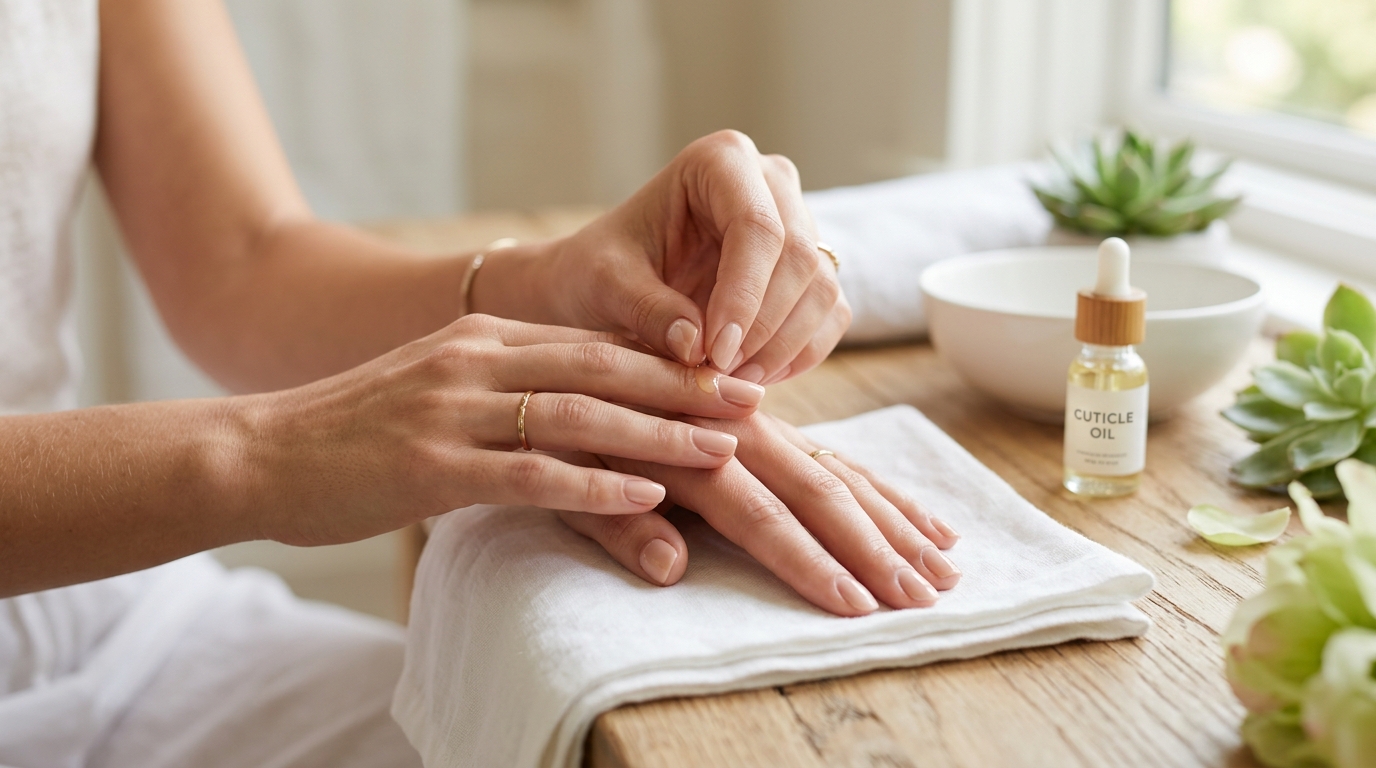
Keep a bottle of cuticle oil everywhere—on your nightstand, at your desk, and in your handbag. Apply a small drop to the base of each nail and massage it in circular motions.
This massage is crucial because it stimulates blood flow to the nail matrix, delivering a rush of oxygen and nutrients that promote faster, stronger nail growth.
2. Put Down the Nippers: Stop Cutting Your Cuticles
We need to talk about the cuticle nippers. It is incredibly satisfying to clip away dry skin, but unless you are a highly trained professional, you should step away from the nippers.
When you cut the living eponychium, your body views it as an injury. In response, it triggers a defense mechanism, rushing to produce tough, thick scar tissue to protect the area. The result? Your cuticles grow back thicker, harder, and more ragged than before. It is a vicious, never-ending cycle.
The Safe Alternative: Pushing Them Back Gently
Instead of cutting, train your cuticles. Once or twice a week, after a shower when your skin is soft, apply a drop of cuticle oil or remover.
Using a wooden orange stick or a silicone cuticle pusher, gently push the softened skin back toward the base of the nail. This clears away the dead cuticle tissue on the nail plate without harming the protective living seal.
3. Moisturize After Every Single Wash
Think about how many times a day you wash your hands. Every time you use soap and water, you strip away the natural oils that protect your skin.
To combat this, make it a rule to apply a rich hand cream immediately after drying your hands. Look for creams containing humectants (like glycerin or hyaluronic acid) to draw moisture in, and occlusives (like shea butter or ceramides) to lock that moisture in place.
4. Give Yourself a Weekly Warm Oil Soak
If your hands are suffering from severe seasonal dryness, a quick application of lotion might not cut it. Treat yourself to a weekly warm oil soak.
Warm up a small bowl of olive oil or coconut oil in the microwave for a few seconds (make sure it is comfortably warm, not hot!). Submerge your fingertips in the oil for 10 to 15 minutes. This deep-conditioning treatment softens stubborn calluses, heals cracks, and leaves your hands feeling unbelievably soft.
5. Protect Your Hands with Protective Gloves
You would not wash your face with harsh dish soap, so why expose your hands to it? Household cleaning products, dish detergents, and even garden soil are incredibly drying and corrosive to your cuticles.
Invest in a few pairs of reusable rubber gloves. Wear them whenever you wash dishes, clean the bathroom, or work in the yard. It might feel like a chore at first, but your hands will thank you.
6. Ditch Harsh Chemicals and Acetone
Traditional nail polish removers are packed with acetone, a powerful solvent that strips away moisture instantly, leaving your nails and cuticles chalky and dry.
Switch to an acetone-free nail polish remover infused with nourishing oils like soy or lavender. While it might take a little more rubbing to remove glitter polish, your cuticles will remain hydrated and happy. Additionally, try to avoid nail products containing formaldehyde, toluene, and dibutyl phthalate (DBP).
7. Feed Your Nails from the Inside Out
No topical treatment can fully make up for a poor diet. Your nails and skin are direct reflections of what you put into your body.
Ensure you are eating a balanced diet rich in:
- Healthy Fats: Avocados, nuts, seeds, and olive oil provide the essential fatty acids your skin needs to maintain its natural moisture barrier.
- Biotin (Vitamin B7): Found in eggs, sweet potatoes, and salmon, biotin is proven to increase nail thickness and prevent brittleness.
- Water: Simple hydration is key. Drinking plenty of water keeps your skin plump and prevents cuticles from drying out in the first place.
—
How to Troubleshoot Common Cuticle Woes
Even with the best care, life happens. Stress, cold winter air, or a weekend gardening project can leave your hands looking a little worse for wear. Here is how to handle emergencies.
What to Do When Your Cuticles are Already Bleeding or Cracked
If you have a painful, open crack or a bleeding hangnail, stop using heavily fragranced lotions, which will only irritate the wound.
Instead, clean the area with mild soap and water. Apply a thin layer of healing ointment (like Aquaphor, CeraVe Healing Ointment, or Neosporin) and cover it with a small adhesive bandage. This creates a moist environment that accelerates healing and keeps bacteria out.
—
Your Daily and Weekly Cuticle Care Routine
To make things easy, here is a simple, highly effective routine you can easily integrate into your busy schedule.
| Frequency | Action Step | Time Required | | :— | :— | :— | | Daily (Morning & Night) | Apply high-quality cuticle oil (jojoba-based) and massage gently. | 1 minute | | After Every Hand Wash | Apply a nourishing hand cream focusing on the nail beds. | 30 seconds | | Weekly | Soften cuticles and gently push them back with a wooden orange stick. | 5 minutes | | Bi-Weekly (or as needed) | Treat your hands to a warm oil soak or overnight "slugging" with cotton gloves. | 15 minutes |
—
Wrapping It Up: The Path to Picture-Perfect Nails
At the end of the day, beautiful nails are healthy nails. By shifting your focus from just painting your nails to actively nourishing your cuticles, you will notice a dramatic difference in how long your manicures last and how strong your natural nails become. Remember, consistency is your best friend here. Keep that bottle of cuticle oil close by, treat your hands with a little kindness, and watch your nails transform from brittle and dry to strong, hydrated, and absolutely stunning.
—
Frequently Asked Questions (FAQs)
Is it ever okay to cut my cuticles?
Generally, no. You should never cut the living skin (the eponychium) at the base of your nail, as this can lead to infections and thicker regrowth. However, it is perfectly safe to carefully clip away loose, dead hangnails that are already detached from the living skin to prevent them from tearing further.
Can I use coconut oil as a cuticle oil?
Yes! Coconut oil is a fantastic, natural moisturizer with antimicrobial properties. While its molecules are slightly larger than jojoba oil, making it absorb a bit slower, it is still highly effective at softening dry cuticles and protecting the skin barrier.
Why do my cuticles get so dry in the winter?
Cold winter air holds very little moisture, and indoor heating strips even more hydration from your skin. Combined with frequent hand washing during cold and flu season, your hands and cuticles lose their natural oils much faster, leading to cracking and hangnails.
How long does it take for damaged cuticles to heal?
With consistent hydration and protection, minor cuticle dryness and small cracks can heal in just a few days. Deeper tears or infections may take one to two weeks to fully repair. Consistent daily oiling is the fastest way to speed up the healing process.
Does hand sanitizer ruin my cuticles?
Yes, frequent use of alcohol-based hand sanitizers can severely dry out your cuticles. Alcohol evaporates quickly, stripping away the natural oils on your skin. To combat this, try to use soap and water when possible, or immediately follow up your hand sanitizer with a moisturizing lotion once it dries.
Post Comment